
“Reflection on the Daily Office: Jonah and the gold mine”

Daily Office for 10/13/2010:  OT Reading – Jonah 1:17 – 2:10

This morning we hear the frightful adventure of Jonah, trapped in the belly of a whale for 3 days. One cannot hear this story and not think of the similarly frightful ordeal of the 33 Chilean miners, trapped more than 1/2 mile below the surface of the earth for almost 3 months. The reading from Jonah captures Jonah’s prayer to God, seeking relief from his current state of bondage in the whale’s belly. God hears Jonah and we are relieved to hear that the whale frees Jonah, spitting him on to the dry land. Again, we are reminded of the ongoing episode of the miners, who are in the midst of rising from the tomb of their entrapment and are free – free to be with their families and friends and free to live life again, but to live life in a very different manner as some of the freed miners have already testified.

We, too, can become entombed by things that contain us: contain and consume us if we allow them to become the center of our lives.  “Those who worship vain idols forsake their true loyalty.” (Jonah 2:8) An exercise for healthy living that always provides benefit is to consider the people and events in your life that hold great significance and reflect on how much time and attention you are giving them. As one of the miners, Mario Sepulvedo, recently told CNN News, “I buried 40 years of my life down there, and I’m going to live a lot longer to be a new person…I think I have learned a lot of wonderful lessons about taking the good path in life.” Like Mario and Jonah, take the time to pray to God, bury the false idols that hold you back and take the good path in life.

“Reflection of the Daily Office: humility, gratitude & love”

Daily Office for 10/07/2010:  Gospel – Luke 7:36-50

This morning we join Jesus dining at the home of a Pharisee named Simon. In the midst of the invited guests, a “woman of the city” (a sinner) enters into the home of Simon and displays great affection toward Jesus – washing his feet with her tears, kissing his feet and anointing his feet with ointment. Simon and his invited guests watch the woman’s display of hospitality with a critical eye, knowing she is a sinner; and they question Jesus’ ability to perceive her true character due to his acceptance of her hospitality. Simon and his dinner guests soon learn that the difficulty in perceiving God’s will rests with them.

Jesus tells a short parable story to highlight the truth of forgiveness: the one who experiences forgiveness of many sins is also filled with much love. The first step in the woman’s journey toward Jesus is recognizing that she has sinned. This is also the first step in our journey – recognizing that many of our actions are centered in what is best for us; our priorities are developed with an internal focus rather than the outward love of others. We can discover great benefits from simply recognizing this condition and opening ourselves, in prayer, to how we might approach our lives differently. Even if we do not begin with actions, but only in reflection, we soon discover that honest reflection leads us to hear Christ’s Gospel with open ears. Hearing the truth of the Gospel and reflecting on our lives leads us to humility, gratitude, and love.

“Reflection of the Daily Lectionary: Do not remain in the Darkness”

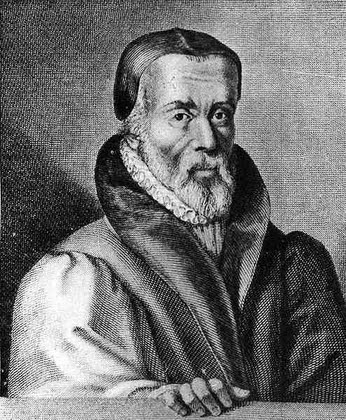
Daily Lectionary 10/06/2010 (William Tyndale):  Gospel – John 12:44-50

Today, we remember William Tyndale, English theologian and one of the most influential biblical translators of the 16th century. Tyndale spent much of his life in hiding, as King Henry VIII of England and those loyal to the king searched for Tyndale throughout continental Europe in hopes of ending his efforts of translating the Bible into English. Those who sought Tyndale eventually achieved their goal and he was captured in 1535 and put to death in 1536. Ironically, the earliest English Bibles (approved by King Henry VIII) owe much of their content to Tyndale’s work.

Today, we reflect on a passage from John’s Gospel account that tells of Jesus’ mission to humanity – to come as a light to the world so that we would not remain in the darkness. Tyndale’s work was focused on bringing the Word of God out of the unavailable languages of Latin, Greek and Hebrew and helping the common English Christian to read the Bible in their native language. Our passage from John’s Gospel account reminds us that we are responsible for reflecting on God’s Word and opening ourselves to the power of God’s message in our lives, as well as serving others as Tyndale did – helping others to come out of the darkness and into the light of God’s love.

“Reflection of the Daily Office: The power of Faith”

Daily Office for 10/04/2010:  Gospel – Luke 5:12-26

Today’s Gospel reading presents us with many lessons…and a rich complexity of issues woven together throughout the story. Among the lessons offered in Luke 5:12-26, the power of faith seems to jump off the page. Jesus is in the midst of a busy crowd and has just healed a leaper and the crowds persist to surround Jesus. The crowds are so great that a paralyzed man cannot come close enough to Jesus to have his healing touch change the man’s life.

“Just then some men came, carrying a paralyzed man on a bed. They were trying to bring him in and lay him before Jesus; but finding no way to bring him in because of the crowd, they went up on the roof and let him down with his bed through the tiles into the middle of the crowd in front of Jesus. When he saw their faith, he said, ‘Friend, your sins are forgiven you.”” (Luke 5:18-20)  Illustration by Graham Kennedy

The Scripture tells us that Jesus saw “their” faith and healed the man. The power of faith has certainly healed the paralyzed man: faith in Christ’s ability to heal body, mind and spirit; and faith in his friends’ ability to get the man to Jesus regardless of the obstacles. The power of faith brings us closer to Christ and places us in the center of the community of believers – only through community are we known as the Body of Christ. Who has carried you to the feet of Christ and who relies on you to break down the barriers that separate them from the healing powers of Jesus?

“The gift of Faith – renewed and rekindled by our actions”

Proper 22C (2 Tim 1:1-14 and Luke 17:5-10)  10/03/2010

John Westerhoff, an Episcopal priest and theologian, shared his understanding of faith development in his book, Will Our Children Have Faith? Westerhoff opens his book by stating, “It is a truism that Christian faith and education are inevitable companions. Wherever living faith exists, there is a community endeavoring to know, understand, live and witness to that faith.”[i] Throughout the remainder of Westerhoff’s book, he clearly explains that his definition of education is not limited to the classroom. The companionship of faith and education is most profoundly experienced as we learn in the fullness of our journey through life. Last Sunday morning at our forum, the St. John’s J2A pilgrims shared highlights from their trip to Scotland and those in attendance heard their profound experiences – experiences that will shape and inform their journey through life. Throughout the forum, each pilgrim came forward and shared some concerns they had before the trip (the potential difficulty of living without electronic gadgets, the discomfort of living on a vegetarian diet, and the unease of traveling with people that you barely know); and they also shared their understanding of life after the trip (garden grown vegetables are not so bad, traveling without electronic gadgets fosters conversation and friendship, and the beauty of the Scottish landscape revealed to them the presence of the holy). The pilgrimage was a profound experience for those who made the trip, but as members of this community, as people who witness the pilgrims’ journey, we encounter the holy and we are profoundly changed as well. Profoundly changed in our understanding of life and profoundly changed in our understanding of faith. The gift of faith, freely given to us from God, but a gift that is ours to grow through our discovery; our determination; our wonder of the holy. Our faith must be “rekindled” as the author of Paul’s letter to Timothy tells us this morning. Continue reading