Maundy Thursday: care & compassion for others

Maundy Thursday (John 13:1-17; 31-35)  4/17/2014

Listen to an audio recording <select here>

Earlier this week many people took time to remember an event that took place one year ago; a tragic event that ripped through the streets of Boston and ripped through the lives of many, many people. We wish we need not remember days like these, but there is some powerful truth about our common life together that is unlocked and exposed for all to see as we experience events that are beyond our control. The bombing at last year’s Boston Marathon was a day that held this truth for us. The marathon in Boston is not just another sporting event, not just a special day for people who like to run distances that immediately make the rest of us wonder where we left our car keys. No, the marathon is a special part of Boston’s character and spirit; run on a celebratory day that remembers the town’s unique place in the struggle that led to the birth of our nation. The bombs did not simply create the tragic deaths of three people and the injuries of hundreds more, but they shattered the peaceful patterns of people’s understanding of a day that had been celebrated for generations. In the immediate aftermath of the bombs’ destructive force, both people and the community’s sense of peace lie in agony. And if that were the end of the story, it would certainly be a story we would hope to soon forget, but that moment was only the beginning of the larger story that continues to this day and beyond. The larger story is the story of the powerful truth about our common life together, and this is the story we must not forget, this is the story we must remember as we gather together in later days. As the Governor of Massachusetts said to those gathered in Boston this past Tuesday, “There are no strangers here. We are all connected to each other, to events beyond our control, to a common destiny.”[i] The powerful truth of that common destiny is that we are called to serve each other, in times filled with joy and in times filled with sorrow.
Continue reading

Temptations and New Perspectives

First Sunday in Lent (Matthew 4:1-11)  3/09/2014

Listen to an audio recording <select here>

Several years ago I attended a dinner party at the home of a friend, an interesting man who has traveled the world during his service in the Navy and had collected many fascinating objects and pieces of art. Wandering through his home was always an adventure. As I passed through his dining room I noticed a beautiful print hanging on the wall, a picture of a woman looking out over the water with a bright and turbulent red sky above. The print was not a simple picture, but was filled with many curious discontinuities. As my friend passed by I asked him to explain the print; he said the print was by Salvador Dali and the name was “Gala Contemplating the Mediterranean Sea”…and, oh yes, it’s also a portrait of Abraham Lincoln.”[i] And then he disappeared into the kitchen to prepare dinner! A portrait of Abraham Lincoln? This beautiful print was both a woman looking over the blue water of the Mediterranean and a curiously hidden portrait of the 16th American President. I looked at this print from every angle and used every ounce of my imagination, but the hidden portrait simply refused to reveal itself. Throughout the evening the print created a constant temptation to solve the mysterious whereabouts of Honest Abe. I would have given anything to unlock the mystery. If there was a bowl of fruit on the table, perhaps an apple that might open my eyes, it would have been very tempting indeed! Continue reading

Will you keep them or throw them back?

Presentation of our Lord (Luke 2:22-40)  2/02/2014

Listen to an audio recording <select here>

Last Sunday we were called by Jesus to drop our nets and our daily entanglements and follow him – “I will make you fish for people,” promised Jesus. Later that same day, I read an interesting news story about a fisherman who spent his entire life fishing in the Mediterranean Sea.[i] The man had died and left behind several pieces of pottery he had pulled from the sea. The relative who received these items called the Antiquities Authority to obtain guidance regarding the disposition of pottery retrieved from the sea that she thought might be a hundred years old. The experts arrived and after a careful inspection informed her the pottery ranged in age from 1000 to over 3000 years old, likely fished out of ship wrecks from the ancient past. All this talk of fishing starting me thinking of a memorable fishing story I experienced as a young boy during a summer trip to Maine with my grandfather and brother. After a full morning of pulling lobster pots, we gathered up our fishing gear and headed back to sea to try our luck fishing for dogfish. Now, other than a few trips to the local river fishing for brook trout, I really had no idea what I was doing and I had no idea what a dogfish even looked like. An hour of working our drop-line fishing gear proved to be completely disappointing, so we called it a day and started to bring in our lines. As I retrieved my line I began to feel a strong tug and I quickly become worried that I had hooked my line on some underwater growth. Everyone encouraged me to keep pulling, and with the assistance of my grandfather and his friend, the line slowly pulled a large grey object in to sight. And as I saw the three foot dogfish below the water I did the only reasonable thing anyone would do if you had never seen a dogfish before…I yelled “SHARK! There’s a SHARK in the water!” As I continued to yell “shark” and did everything in my power to not drop my line and lose the fish, everyone else in the boat found great joy in my terrified amazement. Continue reading

Called to dream, Called to serve

Second Sunday after the Epiphany (Isaiah 49:1-7)  1/19/2014

Listen to an audio recording <select here>

I recently watched a very powerful HBO documentary about a young boy, who was actually quite an old man. The documentary was about Sam Berns, a young boy with a very rare disorder called Progeria. The disorder is a rare disease that involves a specific protein that creates a genetic disruption and causes the body to age very rapidly…this young boy of 13 had the body of an 80 year man. The young boy stated quite firmly, however, that the documentary was about his life, not about the disease. But without the disease, there would have been no documentary; without witnessing the incredible challenges of his life, there would have been no obvious contrast for us to see Sam’s incredible strength and hope. As the story unfolds throughout the documentary, the viewer becomes familiar with Sam and his parents (both medical doctors, helping in their own ways to find solutions to Sam’s disease) and you become increasingly aware of the life and character of Sam and his parents; and eventually the disease is merely the context of the story, not the story itself. No, the story itself is a story of courageous hope, courageous dreams, courageous actions that are taken with an abiding faith and confidence that those actions will make a difference. The courageous actions of Sam and his parents create the story, not the disease. Nowhere in the documentary is this fact better illustrated than in the opening few seconds, just as the story begins. We discover a young 13 year old boy, who looks like a man maybe 6 or 7 times that old, intently working on creating something new. He is surrounded by LEGO blocks, LEGO people and entire LEGO creations spread across a very large table. And as he continues to work on his newest creation he says, “When I’m building LEGOs I feel like I can create my own world…” Sam not only created his own world on that large table, Sam and his parents faithfully created a difference in the world at large – in their community and across the globe. His dreams were not simply left on that big table, Sam’s dreams were coming to life because of his courageous faith and his confidence that his actions could make a difference. Continue reading

Together, a holy calling and Amani ya Juu (higher peace)

Pentecost 20 (2 Timothy 1:1-14)  10/6/2013

Listen to an audio recording <select here>

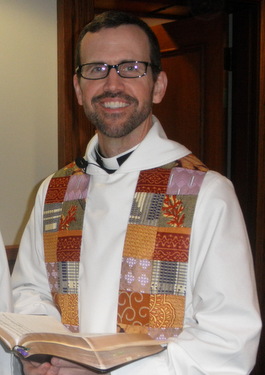
A few years ago, I noticed a seminary classmate of mine wearing a beautiful priest’s stole, designed of patch work fabric. I asked my friend about the stole and she told me that it was made in Africa by a group of women who had formed a cooperative to sell handmade products. The opportunities for women in Africa remain very challenging, and a group of women in Nairobi, Kenya, came together to help each other by forming a program for marginalized women, a sewing and training program to help them work together and grow. The group is called Amani ya Juu, which means “higher peace” in the Swahili language. OLYMPUS DIGITAL CAMERAI purchased a stole for myself and I am wearing it this morning. Since the time I purchased the stole, I think of these women and their families and I pray for them and their success. I also receive newsletters and updates of their work and their progress. This past Wednesday I received an email from the women of Amani and the subject line of the note read, “Westgate Attack in Kenya.” Two weeks ago this morning the Westgate shopping mall in Nairobi was attacked by people who use violence to spread their sectarian religious beliefs and exert their forceful wills upon innocent, peace-loving people. The email from the women of Amani, who are centered in Nairobi, quoted Joyce Muraya, Kenya Country Director for the Amani women’s group: “It is hard to celebrate [that no one from Amani was harmed] when so many have lost their lives…On that Sunday, part of my family made its way to Nairobi hospital to donate blood. We stood in line with people of all races and faiths. As I lay there pumping away watching the red of my blood slowly flood the small translucent bag, next to me was a British lady…Her blood was red too. On the bed next to me my daughter Wamuyu filled her bottle rapidly with red blood. In the queue was a lovely Rwandan woman. We each received a sweet cool drink provided by a business man of Indian extraction. As we were leaving, two Muslim women…came in also to donate blood. Somehow this underlined our common humanity.”[i] In the midst of violence and chaos, the strength and peace of God came from those who responded with compassion using the means available to them; Joyce Muraya’s message highlights this truth. The world in which we live can certainly be a very challenging place, but as we come together, the gifts of the full community of believers creates a positive and powerful force that can take up any challenge. Continue reading

The Intentional Disciple

Pentecost 16 (Luke 14:25-33)  9/08/2013

Listen to an audio recording <select here>

Welcome to everyone as we gather together to begin a new program year and embark on our shared journey of growth, discovery and ministry this year. The time of summer vacations is now nearly over and I hope everyone has some great memories of these past few weeks. I have made several wonderful memories during this past summer. And during this past week as I have reflected on memories of summer fun and other events, I recalled one of the most strange memories I have of summer. As a young boy, my family would drive through Berlin on what is today Route 9, past a section of the town that contains many small ponds created by the old clay pits used to provide material to the local brickyards. In one of those small ponds sits an abandoned crane, with only the very top of the crane’s mast visible above the water. The image of the crane sitting in the middle of the pond always struck me as very odd and I wondered how that might have happened. Over the years I have heard many stories about the old abandoned crane: the operator uncovered a natural spring of water, or perhaps there was a strong rainstorm that appeared quite suddenly (as we experienced last week!), or maybe some mechanical failure of the crane made it nearly impossible to retrieve. Regardless of the cause, the crane’s mast remains above the water as a monument of a very bad day; a cautionary tale of the dangers of distraction. Continue reading

Easter memories & Summer spirituality

Easter VII (Acts 16:16-40)  05/12/2013

Listen to an audio recording <select here>

A couple of months ago I decided to dedicate some time to a hobby that has long interested me, and that hobby is the research of my family history. At first thought there was the anticipation of finding recognizable names from the past: colonial patriots, founding mothers and fathers of this country, and other people that streets and schools and parks are named after. However, once the real work of the research was underway I soon discovered that most of my time was spent sorting through old handwritten documents, visiting the town clerks office, and wandering through old cemeteries. I think the slow and methodical process of sifting through old records was the cause of my previous departures from this hobby in times past, but this time around something very different happened to me. I discovered that mixed in with all the hard, cold facts and figures of those old handwritten documents are the many, many fascinating stories of my family. Family research also provides the opportunity to discover information that has long since been hidden away; sometimes quite accidentally and sometimes quite on purpose. The more information I found, the more questions I had, so I gathered up all my information and set out to talk with as many family members as I thought would have even the slightest memory of the family stories of our past. Interestingly, those conversations began to shape a new understanding of the past and, remarkably, a new vision of how the past guides and informs our future. Thomas Merton, a 20th century monk and spiritual guide, once spoke of how memories must be more than simply facts from the past. Merton wrote, “Memory is not fully itself when it reaches only into the past. A memory that is not alive to the present does not ‘remember’ the here and now, does not ‘remember’ its true identity, is not memory at all. [One] who remembers nothing but facts and past events, and is never brought back into the present, is a victim of amnesia.”[i] Thomas Merton’s insight helps us to realize that memory becomes something far greater when we allow ourselves to move from the idea of simply recalling facts to the living process of remembering and sharing the sacred stories of our lives. Continue reading

Go into all the world and proclaim God’s love

O'CollinsExperiencing Jesus by Gerald O’Collins, SJ; Chapter 5 – “Loving, praying, and forgiving”

We are approximately halfway through our journey of this holy season of Lent. This season calls us to prayer and reflection, a time for us to hear God among us and discover where it is that God is calling us. In the midst of this quiet time of prayer and reflection Gerald O’Collins provides us a chapter that is focused on “action.” I am a fan of all types of communications and social media is only one of the forms that invite us to speak and listen with others, but social media is one way that we have an opportunity to communicate with those who are beyond arm’s length. I was very happy to see that a favorite musician of mine, Harry Connick, Jr., has joined the bite-sized verse world of Twitter. I bring this up because Harry “tweeted” a short thought the other day that stands closely with O’Collins chapter of active discipleship: “March 4th…the only day of the year that means ‘go forward’…so let’s do it.” (You can follow Harry also: @HarryConnickJR).

O’Collins provides a thoughtful overview of God’s abundant love and forgiveness and how prayer pulls everything together. All three of these elements of our relationship with God and others is important, but I would like to reflect especially on the thought of “active” love. The chapter begins, “Many Christians and others have found it attractive to take approval as the primary aspect of love. To love people is, in a most radical way, to approve of, joyfully wonder at, and assent to their existence. The lover rejoices over the object of his or her love and in effect says: ‘It is beautiful that you exist, that you are there in the world’…Unquestionably one can appeal to the Bible in support of this kind of love…Nevertheless, the New Testament relentlessly preaches love as active rather than simply approving. To love is to be engaged selflessly for the good of others and work for their welfare and real happiness.” (pp. 54-55) O’Collins points to the heart of Christian discipleship, the deep well of love that fuels the passion for and the commitment to service in the world…not for the good of the one performing the service, but for the good of God’s created world. The Christian disciple, the one that is connected to the vine, finds love from the fruit of the vine, the real fruit that gives love and life. A life lived in this manner is not always easy, which is why O’Collins rightfully places this conversation within a chapter describing the three elements of discipleship: love, prayer and forgiveness. Finally, O’Collins quotes an insightful statement from G.K. Chesterton: “Christianity hasn’t been tried and found wanting. It has been found hard and not tried.” (p. 59) During this season of Lent, in prayer and reflection, we ask God for the grace to commit ourselves and persevere in the midst of all the joys and challenges that we will face in our daily lives…and then, move forward in love because yesterday was March 4th!

Discovering ourselves as we discover Christ

O'CollinsExperiencing Jesus by Gerald O’Collins, SJ; Chapter 4 – “You leave Jesus out of this!”

The holy season of Lent is a time of prayer and reflection; a time of thoughtful preparation for the events of Holy Week, the events of the Passion of Jesus Christ. If we are to enter in to the mystery and grace of Easter morning, the time of preparation during Lent is a time for us to meet Jesus in an intimate and deeply personal way. However, in the rush of daily life, we can be tempted to simply move through the busyness and leave the prayerful reflections of Jesus behind…this is what Gerald O’Collins is pointing toward in his chapter titled, “You leave Jesus out of this!” Leaving Jesus out of our lives, in some ways, simplifies things…we don’t need to hear the challenging lessons of the Gospel and we don’t need to face the brokenness of our lives, but in this “simplified” approach we are impoverished from the grace and love of Christ, a healing balm much needed in this world of ours. Welcoming Jesus in to our lives is something that may feel overwhelming and complicated at times; admittedly, the images, descriptions, and teachings of Jesus cannot be represented in some simple linear fashion. But we should not expect one image, one lesson, or one thought from the self-revelation of God through his Incarnate Word – there is much to say, much to learn, much to discover as we welcome God in to our lives.

O’Collins includes a wonderful story that highlights his thought that our discovery of God leads to some insightful discoveries of self:

“Some years ago a deacon, who belongs to an Eastern rather than to the Western, Latin rite, was taking a course with me on Christ’s being and doing. Instead of writing a paper, he chose to paint an icon and present it to the class. When he unveiled the icon, stood alongside it and began to speak, my eyes flicked from him to the face of Christ he had depicted. ‘That’s also Joe’s face shining forth from the icon,’ I thought. The face of the artist blended intricately with that of Christ. Far from being surprised at this story, we should expect our efforts to parallel what deacon Joseph did. Searching for Jesus means searching for ourselves. Truly finding him, or rather being found by him, means finding our true selves. Strangers to him, we remain strangers to ourselves.” (p.47)

“Jesus has come – will you welcome him?”

O'CollinsExperiencing Jesus by Gerald O’Collins, SJ; Chapter 3 – “Encountering Jesus”

O’Collins begins his third chapter, “Encountering Jesus,” with two vivid images taken from classic novels. The first image, taken from Boris Pasternak’s Doctor Zhivago, is of the depressed and dejected young Lara sitting in a church considering the complete emptiness of her life. The second image, taken from Evelyn Waugh’s Brideshead Revisited, is of the powerful completion of Charles Ryder’s gradual conversion. Both images invite us to use our imaginations in our search for the presence of God in our world. Both images also share a journey of sorrow or questioning that is broken through by the gentle hand of God, reaching out in ways that are most needed at the time, most needed by the person searching for answers. O’Collins use of these images helps us to consider how it is that Jesus is present to us in our daily lives, and especially present to us during our Lenten journey.

O’Collins presents a scriptural example of the presence of Jesus in the life of Levi (Matthew) the tax collector. Despised in their time, tax collectors were agents of the Roman state that prospered through their exploitation of others and their abuse of the powerless. Yet, it is to one of these despised tax collectors that Jesus comes and calls to a new life of discipleship…and Levi responds to Jesus’ call. Simply said: Jesus has come, Levi has a new life in Christ. O’Collins presents a threefold theme of conversion by representing Jesus’ call in this way: “I have come to call Levi; I have come to share the divine presence; I have come to invite you all to a profound conversion of life.” (p. 35) Jesus has come, and as we open ourselves to the love of Christ in this holy season of Lent may we each be aware of the powerful images of God breaking into our daily lives.