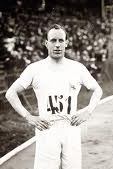
“Fleet of feet and of great patience – Eric Liddell”

eliddellThe second half of winter is nearly always a test of patience; as the longer days of late winter tease that warmer weather is just ahead, the days of February refuse to yield the biting cold of winter. On this twenty second day of February I watched the morning weather report, predicting more accumulating snow with some sleet and ice thrown in for good measure. No worries, our church calendar gives us a gift this morning – the remembrance of Olympic athlete and missionary Eric Liddell. Few of God’s children can boast of having quicker feet, greater patience or the capacity to surrender personal comfort and safety for the good of others like Liddell. His accomplishments on the athletic field and in the missionary field are impressive, and his devotion to his family and those he served throughout his life are quite impressive as well (more information – Eric Liddell Centre). But as I walk my Lenten journey through these cold winter days, I am strengthened by Liddell’s example of strength and perseverance. As we remember him today we pray from the words of the prophet Isaiah: “Those who wait for the LORD shall renew their strength, they shall mount up with wings like eagles, they shall run and not be weary, they shall walk and not faint.” (Isaiah 40:31) Isaiah’s words are beautiful and inspiring, but the paradox of the words should not be lost: in waiting there is strength, and as we wait we will be able to fly, to run and to walk without losing the strength the LORD has given. It seems to me that these words of paradox describe Eric Liddell and exemplify his steadfast faith in God – he was one of the fastest men of his time, yet he showed great patience as he served God through his missionary work. I pray that we all may patiently wait for the LORD and then serve without hesitation when called…no matter the weather!

“God whose strength bears us up as on mighty wings: We rejoice in remembering your athlete and missionary, Eric Liddell, to whom you gave courage and resolution in contest and in captivity; and we pray that we also may run with endurance the race set before us and persevere in patient witness, until we wear that crown of victory won for us by Jesus our Savior; who with you and the Holy Spirit lives and reigns, one God, for ever and ever. Amen.” Collect for the remembrance of Eric Liddell, February 22nd

“‘Let anyone with ears listen;’ proclaiming the truth – Eyal Press’ Beautiful Souls”

BeautifulSoulsBeautiful Souls by Eyal Press, Chapter 4: The Price of Raising One’s Voice

Chapter 4 of Eyal Press’ Beautiful Souls turns our attention to the courageous proclamation of the truth; the dissenting voices of truth that break through the silence of the group. Press’ main character in this final chapter is Leyla Wydler, a tough and determined woman who has enjoyed a successful career as a financial adviser until she runs up against the challenges of the Stanford Group Company in Houston, TX. The chapter begins with an anonymous letter sent to various government financial authorities as well as a few media organizations, all in an effort to attract attention to suspected illegal activities at a well respected global financial firm. We quickly learn the suspicious mind behind the letter is Wydler and we also learn of the great courage and tenacity it took her to come to this point in her life…and the consequences her courage would bring upon her and her family. Proclaiming the truth in the midst of a group (or an entire society) that sees no wrong, perceives no harm, or believes no lies have been told is a difficult and often disorienting adventure. Press takes his readers on this adventure and allows us to see through the eyes of those who have proclaimed the truth and challenges us to hear and act. Continue reading

“Personal conscience and moral imagination – Eyal Press’ Beautiful Souls”

BeautifulSoulsBeautiful Souls by Eyal Press, Chapter 3: The Rules of Conscience

Press opens his third chapter with the story of Henry David Thoreau and Thoreau’s famous support for claims of personal conscienceness and actions of civil disobedience. Press quotes Thoreau: “I am not responsible for the successful working of the machinery of society. The only obligation which I have a right to assume, is to do at any time what I think right.” Press insightfully evaluates Thoreau’s starkly individualistic claim, “[Thoreau’s claim] is a bracingly uncomprimising worldview. But if this is all that saying no entails, what beyond salving one’s own conscience comes of it? If one person’s subjective values can be invoked to break the law and resist government, why can’t another, radically different set of personal convictions?” (p. 87) Press continues to pose questions, but his point has already been made – who gets to decide “right” and “wrong.” Differing sides could take up the argument for a long time and ideological trench warfare ensues…if you are sceptical, look at Washington, D.C. and the lack of progress that has come out of the recent political quagmire there. Press introduces us to his main character of chapter 3, Avner Wishnitzer, and takes us on a journey describing Avner’s experience in the Israeli Army, a journey that helps to answer the question of personal conscience. Continue reading

“Courageously pursuing the Truth – Eyal Press’ Beautiful Souls”

BeautifulSoulsBeautiful Souls by Eyal Press, Chapter 2: Defying the Group

While continuing to focus on the courageous acts of individuals, Eyal Press takes up the question of group dynamics in his second chapter, “Defying the Group.” The setting of the main story of interest is the Balkans in the early 1990’s and the tensions and eventual bloodshed between Serbs and Croats of the former Yugoslavia. Press’ main character, Aco Jevtic, is a Serb caught in the midst of the terrible battle that waged over the city of Vukovar. We learn of Jevtic’s struggles in Vukovar only later, but first Press wants us to center our attention on Jevtic’s courageous and, for many puzzling, act to save Croats from torture and possible death. Jevtic finds himself among a large group of men captured by Serbian forces; and eventually a Serbian officer who recognizes Jevtic asks him to identify fellow Serbs among the prisoners so they may be removed. Jevtic complies with the officer’s request but does not stop pointing out men after all the Serbs have been identified, instead pointing toward men he knows are Croats but giving them false names in order to save them. Jevtic’s courageous actions save countless Croats, while at the same time placing himself in great danger should his actions become discovered. Why would Jevtic boldly take this course of action during dangerous times of ethnic violence? Continue reading

“Gifts of the Spirit, participating in God’s Love”

Epiphany 2C (1 Cor 12:1-11)  01/20/2013

Listen to an audio recording <select here>

Just a few weeks after my graduation from college, several friends of mine and I moved to Orlando, FL in order to attend a six month Navy training course. I had known one of my roommates throughout my college days and he had become a great friend. A person of integrity and intelligence, he was a steady and thoughtful presence during those demanding days of school. We shared many long days, lots of laughs, and some challenging times, but we were confident of our future and we had great plans. My friend was going to serve his commitment to the Navy and then leave the service behind to pursue other interests. I was sure of my future in the Navy and I fully intended to make a career of it, 20 years or more. We had different visions of our future, but we were both quite confident we knew the things that mattered most in our lives and we were determined to achieve our goals. Continue reading

“Transformation through personal experience – Eyal Press’ Beautiful Souls”

BeautifulSoulsBeautiful Souls by Eyal Press, Chapter 1: Disobeying the Law

Eyal Press begins his book with a story of an unlikely law breaker, the Commander of the State Police in St. Gallen, Switzerland. Paul Gruninger was, by all accounts, a good and faithful civil servant for many years; a family man; a man that could be trusted with the law and order of his community. Yet, Paul Gruninger was indicted and convicted of breaking the very laws he was entrusted to uphold…how could this have happened? The simple answer is that there is no simple answer, especially in the difficult and dark days of the spreading horror of World War II in Europe. After experiencing an overwhelming influx of Jewish refugees throughout the 1930’s, Switzerland decided that there was no more room within its borders and after August 19, 1938, immigration for any reason was denied. Gruninger, serving on the border of Austria and familiar with the horrors that were present in that border country, could not bring himself to follow this new immigration law. He regularly accepted new immigrants fleeing Austria and falsely dated their paperwork with dates prior to August 19. His life-saving but law breaking activities were eventually discovered and he was promptly removed from his position and discredited for the remainder of his life. His actions may have saved countless lives, but he dramatically changed his life and the fortunes of his family. Why did the Commander of the State Police break the law? Continue reading

“Moral Conscience and Nonconformity – the price of saying no: Eyal Press’ Beautiful Souls”

Beautiful Souls, by Eyal PressBeautifulSouls

During the next few weeks Eyal Press’ insightful book will be examined in preparation for a book review prior to the start of our journey through Lent. The book explores the fascinating moral dilemmas and difficult circumstances of people who have become trapped between the ideals of their conscience and the unfolding actions of the society in which they find themselves. A small group of people appear to have the moral courage to resist the path of least resistance and cling to their deeply held principles; what is their secret? In Press’ own words: “Why, even in situations of seemingly total conformity, there are always some people who refuse to go along. This is a book about such nonconformists, about the mystery of what impels people to do something risky and transgressive when thrust into a morally compromising situation: stop, say no, resist.” (Beautiful Souls, p. 5)

The season of Lent brings us on a journey with Christ as he walks the difficult last days of his public ministry and uncompromisingly sacrifices everything at Golgotha; he is willing to go to any length for those he loves, including death on the cross. The time of Lent is a time for reflection; a time to go deeper into one’s personal faith; a time to explore the call of discipleship and the personal cost associated with a deep and active faith in Christ. Eyal Press’ book, Beautiful Souls, will help raise important topics and lead us in deeper personal understanding and awareness.

Please read a New York Times Sunday Book Review of this book <select here>

“May the Light of Christ move you in this New Year”

Epiphany (Matthew 2:1-12) 01/06/2013

To listen to an audio recording <select here>

Happy New Year! The New Year always brings an opportunity that I look forward to each year, an opportunity to find some new and interesting calendar to guide the days and months ahead. And as we take down last year’s calendars and replace them with new ones, we too have been given an opportunity to renew our lives and begin this New Year with a fresh start. The end of the year also invites us to spend some time in reflection, giving some thought to these past twelve months; where we have been, what we have seen, and how we might approach this coming year with new and enlightened understandings of our world. During this past year we have experienced many challenges: Hurricane Sandy, Sandy Hook School and the fiscal cliff…and that just covers the past three months. But we have also witnessed the joys of watching the world come together in London for the Summer Olympics and closer to home we have heard from our young Pilgrims and their trip to Belize and our community has visited our friends in Haiti and Cuba. Our experiences of this past year are memories now, but our reflections provide us with insights that help us to learn and grow into a new year of hope filled opportunities; opportunities that await us if we are willing to turn our faith in Christ into actions of love and service. Continue reading

“‘Evil can be undone, but it cannot develop into good.’ C.S. Lewis’ The Great Divorce”

The Great Divorce, by C.S. Lewis

Over the course of the next few weeks, C.S. Lewis’ classic book will be examined in preparation for a book review at the end of October. The subject of Good vs. Evil, Heaven vs. Hell, is a subject that can fill bookshelves and yet defy an overwhelming conclusion. Like Lewis himself, we will through caution to the wind and jump in to the deep-end of this subject, using his journey through both Heaven and Hell as our guide.

Lewis describes his intention for The Great Divorce in its Preface, stating that his work will bring the reader on a journey that is quite intentionally a fantasy, but a fantasy with a moral. Lewis clearly presents his case that good and evil are available to all; and with evil seemingly lurking around the next corner the choice for the good is an intention that requires personal attention and faithful (and courageous) practice. I am reminded of the Apostle Paul’s words of encouragement to the Philippians, “work out your salvation with fear and trembling; for it is God who is at work in you, enabling you both to will and to work for his good pleasure.” (Phil 2:12b-13) We are not alone, for “it is God who is at work in you” but we are not passively waiting for some external improvement…no reclining back like we are at the dentist’s office waiting for the pearly white crown to be placed over the ugliness of what lies beneath; this is the real road of discipleship.

Lewis makes us want to pursue that road by ensuring that the wisdom of the journey will bring us into God’s presence. He writes that for those who have sought the Reign of God and have finally come to know the glory of God at the journey’s end, their wisdom can be only known from the journey’s far end: “In that sense it will be true for those who have completed the journey (and for no others) to say that good is everything and Heaven everywhere. But we, at this end of the road, must not try to anticipate that retrospective vision. If we do, we are likely to embrace the false and disastrous converse and fancy that everything is good and everywhere is Heaven.” (Preface, pg. IX)

And so our journey with C.S. Lewis through both Heaven and Hell begins and his insights of good vs. evil through his story of fantasy promises to enlighten us in the days ahead. As Paul prayed for the Philippians, so we pray, “that your love may overflow more and more with knowledge and full insight to help you to determine what is best, so that in the day of Christ you may be pure and blameless, having produced the harvest of righteousness that comes through Jesus Christ for the glory and praise of God.” (Phil 1:9-11)

“Following Christ beyond the classroom”

16th Sunday after Pentecost (Mark 8: 27-38)  09/16/2012

Listen to an audio recording <select here>

Earlier this week I received my monthly college alumni magazine. I always enjoy getting caught up on the latest news about my classmates and this month I was also reminded that this year will be the 25th reunion of my college graduation; a time to remember and celebrate a milestone of hard work, an accomplishment of four years of learning. I remember four years of college was followed by another year of specialized training and then I finally arrived at my first ship. As I walked aboard the submarine I was welcomed by one of the ship’s Chief Petty Officers; he said, “Welcome to the real Navy, Mr. Perkins.” The “real” Navy, what was that supposed to mean? I replied, “I have been in the Navy for more than five years, Chief.” Unimpressed, this experienced sailor told me to keep my eyes and ears open, listen to the Chief Petty Officers and I would eventually learn about being a Navy sailor. A few years later, as I was preparing to leave the Navy and join the business world, I thought business school would be a wise decision, a way to better understand the new world I was about to enter. Business classes were very helpful in my preparation to embark on my new career, but remembering the experienced sailor’s advice, I wondered if the information I learned in the classroom would be enough? In a recent news article written by a business leader and author, that same question is considered: can the classroom provide students everything they need to know about the world of business? The author presents the advantages of classroom instruction combined with practical training in the field and asks the reader to consider this thought: “Whatever led us to imagine that classroom teaching alone was a smart way to teach anything practical, like law or business?”[i] The article holds up the medical teaching hospital as the ideal and praises the model of teaching students “where their subject is taking place in front of their eyes.”[ii] An interesting question: “Whatever led us to imagine that classroom teaching alone was a smart way to teach anything practical, like law or business”…or being a follower of Jesus? Continue reading