
No worries, just be a Witness!

Seventh Sunday of Easter (Sunday after the Ascension) (Acts 1:6-14)  6/01/2014

“As they were watching, Jesus was lifted up, and a cloud took him out of their sight. While he was going and they were gazing up towards heaven, suddenly two men in white robes stood by them. They said, ‘Men of Galilee, why do you stand looking up towards heaven?'” (Acts 1:9-11) These three short verses of Scripture from the Book of Acts are among my favorite verses in the Bible, for many reasons. Just prior to this description of the Ascension of Jesus into heaven, we are told of the many post-resurrection appearances of Jesus and the final lessons he hoped to give to his followers, teaching them how to spread the Good News of Christ. But now the time has come for Jesus to leave them, and leave them he does…and they are left standing by themselves, filled with awe and more than just a little worry in their hearts. Suddenly, two heavenly beings burst into this dramatic moment with a question: “Why are you standing there looking up to heaven?” I really love this question because it is so simple, yet so challenging at the same time. I feel some kinship with the disciples as they gaze to the heavens with their mouths hanging open, the universal sign of “my goodness, what’s next?” The Ascension of Christ marks the 40th day of Eastertide, and in those forty days Jesus continually prepared his disciples for the next chapter of their ministry in the world. And we have heard throughout these past weeks that the disciples often did not really understand Jesus’ lessons to them; again, I feel some kinship with these earliest followers of Christ! And now, Jesus has departed from their midst; their great rabbi, their teacher, has ascended and left them to carry on…a bit overwhelming! What should we think of this story; what can we say about our first class of Christians? Should we understand the Ascension as a graduation story or something else entirely? Continue reading
Temptations and New Perspectives

First Sunday in Lent (Matthew 4:1-11)  3/09/2014

Listen to an audio recording <select here>

Several years ago I attended a dinner party at the home of a friend, an interesting man who has traveled the world during his service in the Navy and had collected many fascinating objects and pieces of art. Wandering through his home was always an adventure. As I passed through his dining room I noticed a beautiful print hanging on the wall, a picture of a woman looking out over the water with a bright and turbulent red sky above. The print was not a simple picture, but was filled with many curious discontinuities. As my friend passed by I asked him to explain the print; he said the print was by Salvador Dali and the name was “Gala Contemplating the Mediterranean Sea”…and, oh yes, it’s also a portrait of Abraham Lincoln.”[i] And then he disappeared into the kitchen to prepare dinner! A portrait of Abraham Lincoln? This beautiful print was both a woman looking over the blue water of the Mediterranean and a curiously hidden portrait of the 16th American President. I looked at this print from every angle and used every ounce of my imagination, but the hidden portrait simply refused to reveal itself. Throughout the evening the print created a constant temptation to solve the mysterious whereabouts of Honest Abe. I would have given anything to unlock the mystery. If there was a bowl of fruit on the table, perhaps an apple that might open my eyes, it would have been very tempting indeed! Continue reading

Called to dream, Called to serve

Second Sunday after the Epiphany (Isaiah 49:1-7)  1/19/2014

Listen to an audio recording <select here>

I recently watched a very powerful HBO documentary about a young boy, who was actually quite an old man. The documentary was about Sam Berns, a young boy with a very rare disorder called Progeria. The disorder is a rare disease that involves a specific protein that creates a genetic disruption and causes the body to age very rapidly…this young boy of 13 had the body of an 80 year man. The young boy stated quite firmly, however, that the documentary was about his life, not about the disease. But without the disease, there would have been no documentary; without witnessing the incredible challenges of his life, there would have been no obvious contrast for us to see Sam’s incredible strength and hope. As the story unfolds throughout the documentary, the viewer becomes familiar with Sam and his parents (both medical doctors, helping in their own ways to find solutions to Sam’s disease) and you become increasingly aware of the life and character of Sam and his parents; and eventually the disease is merely the context of the story, not the story itself. No, the story itself is a story of courageous hope, courageous dreams, courageous actions that are taken with an abiding faith and confidence that those actions will make a difference. The courageous actions of Sam and his parents create the story, not the disease. Nowhere in the documentary is this fact better illustrated than in the opening few seconds, just as the story begins. We discover a young 13 year old boy, who looks like a man maybe 6 or 7 times that old, intently working on creating something new. He is surrounded by LEGO blocks, LEGO people and entire LEGO creations spread across a very large table. And as he continues to work on his newest creation he says, “When I’m building LEGOs I feel like I can create my own world…” Sam not only created his own world on that large table, Sam and his parents faithfully created a difference in the world at large – in their community and across the globe. His dreams were not simply left on that big table, Sam’s dreams were coming to life because of his courageous faith and his confidence that his actions could make a difference. Continue reading

Close the almanac and say a prayer

Pentecost 22 (Luke 18:1-8)  10/20/2013

Listen to an audio recording <select here>

Information is an important part of our society today. We are connected to the news of the world in ways that were unimaginable just a few short years ago. Information feeds our curiosities and gives us confidence that we are in touch with our world. However, information of the “here and now” is not the only information that peeks our interest. We are not quite halfway through the fall season and I have already spotted my first winter prediction in the newspaper. Predicting the coming season’s weather has been a fascination with people for generations. I remember reading the Old Farmer’s Almanac as a young boy, intrigued that the details of the weather could be known so far in advance, and I soon learned that the Almanac was not always correct. Long-term predictions would have struggled to capture the fierce storm from nearly two years ago, an epic October snow storm that disrupted our way of life for a week or more. Throughout those days, many of us sought some solace, some hope in the power company’s outage maps and restoration predictions. And as the days dragged on through the week, it became difficult to believe the information given to us and not lose heart with our circumstances. This morning, our Gospel lesson offers us an interesting twist on how we might inform our lives, how we might live a life of faithfulness and hope-filled confidence by telling a story of a determined woman and an unjust judge who sat in judgment of her future. Continue reading

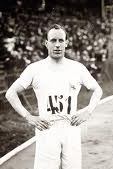
“Fleet of feet and of great patience – Eric Liddell”

eliddellThe second half of winter is nearly always a test of patience; as the longer days of late winter tease that warmer weather is just ahead, the days of February refuse to yield the biting cold of winter. On this twenty second day of February I watched the morning weather report, predicting more accumulating snow with some sleet and ice thrown in for good measure. No worries, our church calendar gives us a gift this morning – the remembrance of Olympic athlete and missionary Eric Liddell. Few of God’s children can boast of having quicker feet, greater patience or the capacity to surrender personal comfort and safety for the good of others like Liddell. His accomplishments on the athletic field and in the missionary field are impressive, and his devotion to his family and those he served throughout his life are quite impressive as well (more information – Eric Liddell Centre). But as I walk my Lenten journey through these cold winter days, I am strengthened by Liddell’s example of strength and perseverance. As we remember him today we pray from the words of the prophet Isaiah: “Those who wait for the LORD shall renew their strength, they shall mount up with wings like eagles, they shall run and not be weary, they shall walk and not faint.” (Isaiah 40:31) Isaiah’s words are beautiful and inspiring, but the paradox of the words should not be lost: in waiting there is strength, and as we wait we will be able to fly, to run and to walk without losing the strength the LORD has given. It seems to me that these words of paradox describe Eric Liddell and exemplify his steadfast faith in God – he was one of the fastest men of his time, yet he showed great patience as he served God through his missionary work. I pray that we all may patiently wait for the LORD and then serve without hesitation when called…no matter the weather!

“God whose strength bears us up as on mighty wings: We rejoice in remembering your athlete and missionary, Eric Liddell, to whom you gave courage and resolution in contest and in captivity; and we pray that we also may run with endurance the race set before us and persevere in patient witness, until we wear that crown of victory won for us by Jesus our Savior; who with you and the Holy Spirit lives and reigns, one God, for ever and ever. Amen.” Collect for the remembrance of Eric Liddell, February 22nd

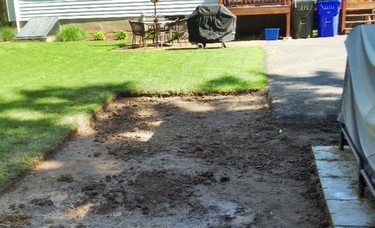
“When is a patio not a patio?”

A trick question? “When is a patio not a patio?” And, no, the answer has nothing to do with the fact that the “patio” is not a patio because it is a bunch of processed gravel…this is true, but I’m working on the gravel pit and by the end of the summer the patio will be there…I promise. So back to the question at hand…and the answer (as seen below) is that a patio is not a patio when it is a parking lot. That’s right, my home project of building a “patio” will serve as a parking lot for the near future, but that doesn’t deter me from knowing that I am building a patio (and in my plans, there is a wonderful fire pit and space for a table & chairs and some nice reclining chairs too). Why does any of this matter or have any bearing on one’s daily life?

Last Sunday’s Epistle reading was from Paul’s letter to the Corinthians, with Paul encouraging the Christians in Corinth with the following: “As we work together with Christ, we urge you also not to accept the grace of God in vain. For he says, ‘At an acceptable time I have listened to you, and on a day of salvation I have helped you.’ See, now is the acceptable time; see, now is the day of salvation! We are putting no obstacle in anyone’s way, so that no fault may be found with our ministry…” (2 Cor 6:1-3) Paul’s intent is a defense of his ministry and his theology of life in Christ, but he also exhorts the Corinthians that life in Christ is a life lived wide-open; a life that is full of love and possibilities…and, importantly, that life begins now! And so, back to the patio, that is a parking lot, that is a patio – do not wait for life to align exactly as you believe it must look before jumping off and getting involved in all that life has to offer. The sooner you jump and join the fun, the better off you will be…and the better off everyone else around you will be because you have joined the party. Paul lists all the hardships he and his friends have endured (2 Cor 6:4-13) but ends this section of his letter by telling the Corinthians that the hardships have not prevented his participation in the “here and now” of life and in the acceptance of the grace of God given to him: “We have spoken frankly to you Corinthians; our heart is wide open to you. There is no restriction in our affections, but only in yours. In return – I speak as to children – open wide your hearts also.” (2 Cor 6:11-13) So, open wide your hearts and be open to the possibilities of life – even if the patio looks like a parking lot…

“The Incarnate God among us”

The Third Sunday of Easter (Luke 24:36-48)  4/22/2012

Listen to an audio recording <select here>

Several months ago the Global Missions Committee began planning a trip to visit our companion church in Cuba. As the planning continued over the course of several weeks we learned more about the travel arrangements, the needs of the church in Santa Cruz del Norte, and we learned more about the Cuban people of our companion parish. Two weeks ago today, on Easter Sunday, we packed our cars full of eight bags of needed supplies and readied ourselves for an early Monday morning, arriving at the airport before sunrise. Our journey continued and with each moment we moved closer and closer to the community of Santa Cruz: we navigated through security lines, encountered long bag check lines, we lost our luggage, we found our luggage, and we finally arrived in Havana. We soon met Father Frank, members of the Cathedral staff, and when we arrived in Santa Cruz del Norte on Wednesday we met the eagerly waiting members of our companion church – all in the flesh. We can learn many important pieces of information via email and over the phone, but experiencing people up close and in the flesh is an experience that cannot be matched by any form of long distance communication. Throughout our week long visit to Cuba, our personal interactions with our Cuban friends profoundly shaped our experience and were the source of our lasting impression of their hospitality and grace. Continue reading

“Will Our Children Have Faith?”

Will our children have faith? An interesting question, and the title of an informative and insightful book by John Westerhoff, III. Although first published in 1976 and revised in 2000, the book is just as relevant as the first day it was printed. And you might wonder, is it important that our children have faith…is this aspect of our lives important to us, both individually and collectively? The Pew Forum on Religious and Public Life published a study in December 2009 entitled “How Religious is your State?” – the results varied, but the national averages showed that slightly more than half of those surveyed thought weekly worship attendance and daily prayer were important, while about 70% were certain of the existence of God. So, at least in some degree (and definitions vary widely, of course) faith in God still has significance in our society. This begs the question, if something is important, what are we doing about it? Westerhoff opens his book with the following words: “It is a truism that Christian faith and education are inevitable companions. Wherever living faith exists, there is a community endeavoring to know, understand, live, and witness to that faith.”[i] Again, what are we actually doing about the development of our faith; how are we “endeavoring to know, understand, live, and witness to that faith.” Certainly there are many wonderful programs alive and well throughout the country, but there are also many disturbing trends that appear to be going unnoticed. Continue reading

“Covenant partners with God: what you do does matter!”

1st Sunday of Lent (Genesis 9:8-17)  02/26/2012

On this first Sunday of Lent, as we have now made our way through the first few days of our Lenten journey, my hope is that you have already set aside some time and have jumped in to this season by taking advantage of some of the many offerings at St. John’s Church or have decided on a few of your own. If not, I hope you have had the opportunity to at least consider something that you might like to try out during the days and weeks ahead. As for me, I have taken up an invitation from Jeffrey Lee, Bishop of Chicago, to read a book and follow Bishop Lee’s discussion questions and reflections. The book is entitled, A Practical Christianity: Meditations for the season of Lent, by Jane Shaw. The Rev. Shaw is the Dean of Grace Cathedral, located in San Francisco, CA. Her book is about the practices of Lent rather than the beliefs (or the theology and doctrines of Christianity) that we feel we must subscribe to. In the introduction to her book, Shaw writes, “For the earliest converts to Christianity, the question before they were baptized and joined the Christian community was not so much “What do you believe?” as “How has your life been transformed?”[i] I will be reading the book as a Lenten guide, so I have only read the introduction so far, but Shaw provides a wonderful overview and clearly outlines her intentions for the book. She makes the following points: Christians should not get wrapped up in difficult theologies and doctrines as they travel through their Lenten journey; more importantly, and consistent with the practices of the Early Church, is the notion that what we do is as important, if not more formative, than what we believe. Consistent with the Anglican understanding of “lex orandi, lex credendi: out of the law of praying comes the law of belief” or perhaps more practically, what you do becomes what you believe, and eventually this will form the shape of your life, your life with God and your life with your neighbor. Shaw’s book presents itself as an interesting guide to the journey of practical self-reflection toward one’s personal life, one’s relationship with God and relationship with others. Her book provides guidance on a journey that explores the many aspects of one’s relationships and it is a journey that I am looking forward to taking up throughout these forty days of Lent. Continue reading

“You have been chosen and now you must choose!”

6th Sunday after the Epiphany (Mark 1:40-45)  2/12/2012

Listen to an audio recording <select here>

The leper said to Jesus, “If you choose, you can make me clean.” (Mark 1:40) “If you choose…” Every day we are all confronted with decisions that must be made; in the course of our lives we discover new opportunities that cause us to make choices. Two weeks ago today I had the opportunity to spend the morning education hour with the J2A Youth group, helping them prepare for their approaching confirmation at the Cathedral. Our discussion was based upon a lesson that was entitled, “Decisions, Decisions.” As young adults in the church, they are already becoming familiar with the idea that their decisions are more informed by their own choices than with the choices of their parents or their guardians. And they, like the rest of us, have some choices to make. The Sacrament of Confirmation, according to the Prayer Book, is a mature commitment to Christ; a choice to affirm and renew the vows taken at one’s Baptism. The lesson prepared and challenged these young folks to consider how they might react when confronted with choices, especially choices made under difficult circumstances.  Every Christian has choices to make and many of the choices we are confronted with are not easy choices; and they are not always choices that are obvious or popular to the society in which we live. Continue reading